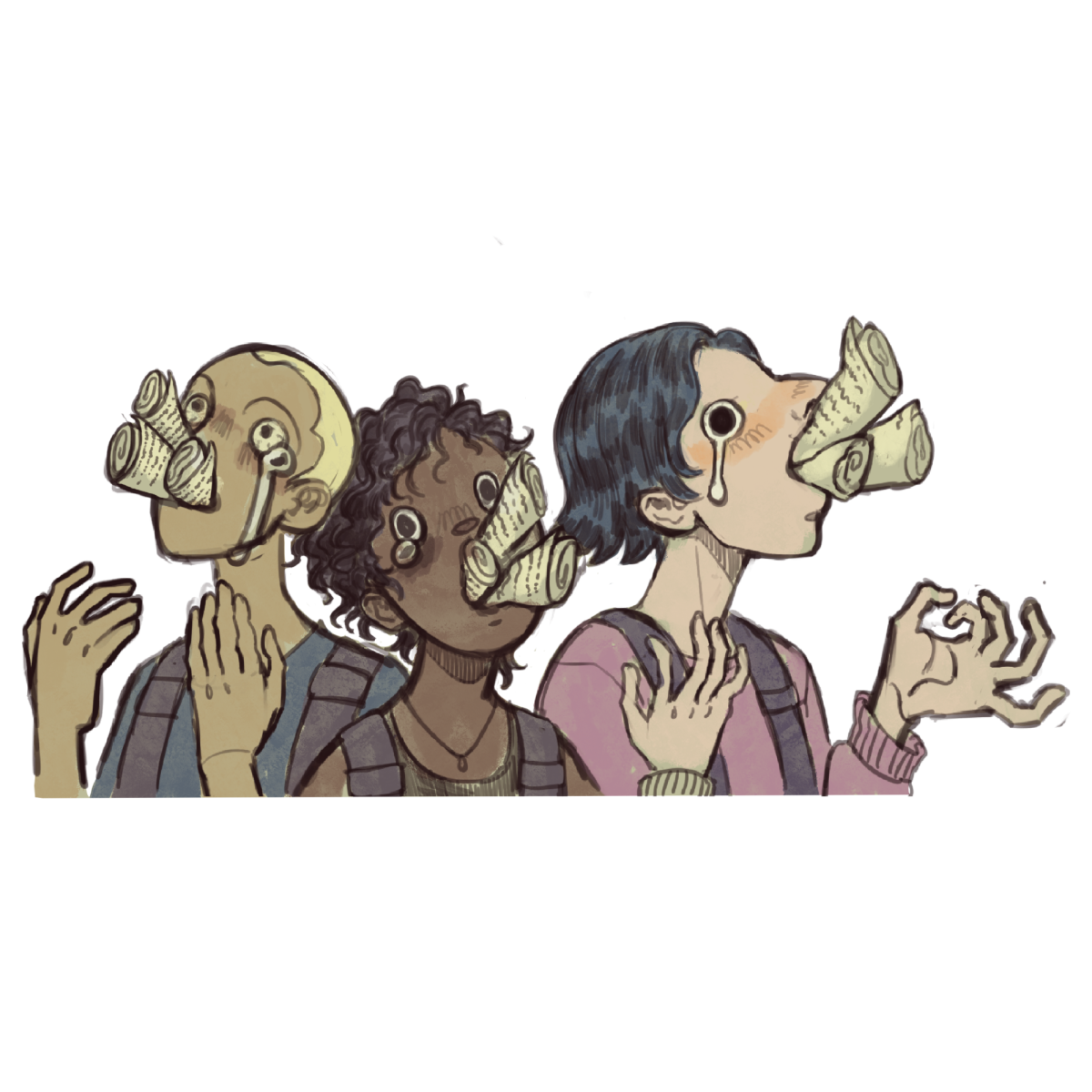
William Keats coined “negative capability” to describe “when man is capable of being in uncertainties, Mysteries, doubts, without any irritable reaching after fact & reason.” In other words, the value of writing can be found in what the author avoids mentioning rather than what the storyteller states. Many notable writers employ the negative capability to develop nuance through characters’ ambiguity. Emily Brontë remains among those great writers.
In her upcoming film adaptation of Brontë’s “Wuthering Heights,” Emerald Fennell exploits the negative capability of Brontë’s seminal work to offer a film adaptation of the Victorian novel that, while being considered controversial for some, is not inherently wrong.
Controversy particularly underscores the casting of Jacob Elordi, a white actor, in the role of Heathcliff — a character often racialized by readers. However, assuming Heathcliff’s race proves fickle since Brontë never confirms the character’s race or ethnicity. Allusive hypotheses made by Mr. Earnshaw, Nelly and Mr. Linton place Heathcliff on society’s outskirts. However, the text never provides a definitive answer to the matter of his race or ethnicity.
Earnshaw describes the scoundrel as “a dark skinned g—psy, in aspect.” In chapter seven, Nelly comments, “A good heart will help you to a bonny face, my lad, if you were a regular Black.” Her statement alludes to the possibility of Heathcliff being mixed race, specifically Black. However, later she laments, “You’re fit for a prince in disguise. Who knows but your father was Emperor of China, and your mother an Indian queen.”
Earnshaw and Nelly do not confirm a specific race or ethnicity.
Their suspicions become slightly diminished when Mr. Lanton classifies Heathcliff as “a little Lascar, or an American or Spanish castaway” in chapter six. Castaway connotes Heathcliff’s darkness being born of the sun rather than genetics. Lanton’s comments introduce the possibility of Heathcliff’s darkness and uncanny nature being linked to his status as a laborer and the working class, rather than resulting from genetics.
Heathcliff’s race remains open for interpretation. In Fennell’s case, she seems to be opting for an adaptation that homes in on Lanton’s comments rather than Earnshaw’s and Nelly’s. This decision to move away from race and into social class aligns with themes found in the earlier works of Fennell, especially class commentary of “Saltburn,” and proves a smart move for the white director, who may have missed nuance had she chosen to concentrate on race.
Provocative art must be undefined. It creates a conversation between itself and its audience. In the case of Brontë’s “Wuthering Heights,” that dialogue occurs between the text and Fennell. This film is Fennell’s interpretation.
While it may contradict the reading of some audiences, Fennell’s rendition succeeds in its creation of discourse. After all, art is not meant to offer a message, but rather generate conversation within the self, among strangers and with the past.