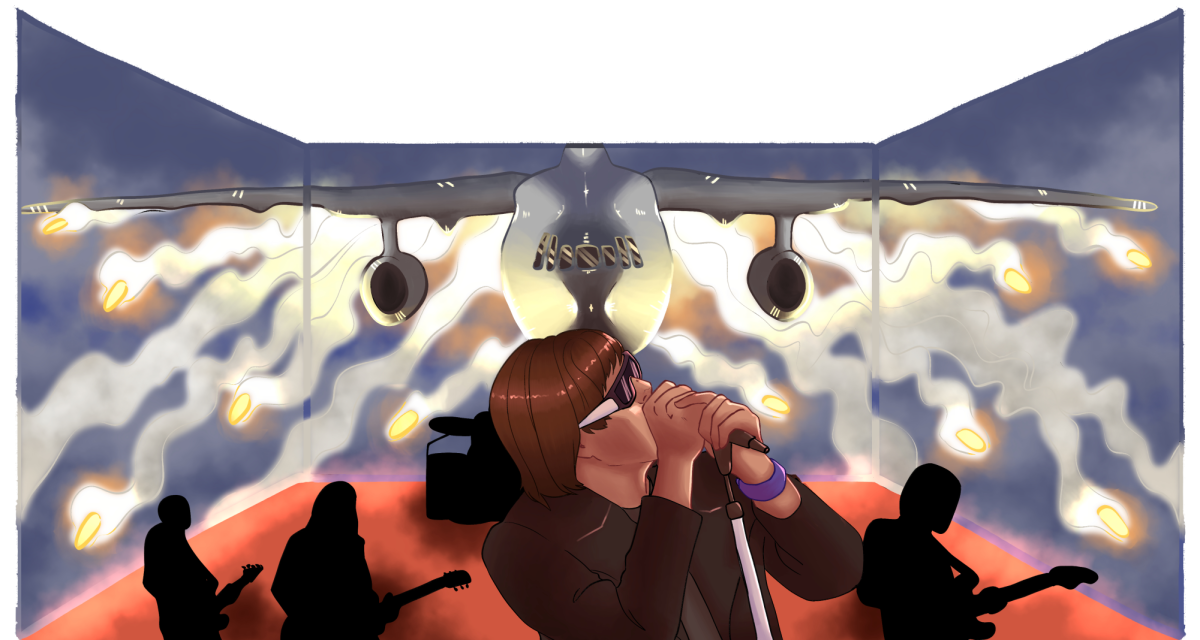
President Donald Trump’s address at a rare meeting of the nation’s highest-ranking military leaders in Quantico, Virginia marked a terrifying departure from rhetoric that is acceptable for the Commander-in-Chief. Couched between his usual rambling, self-aggrandizing remarks and rehashing years-old petty grievances, Trump tells the nation that the military will be used to fight “the enemy within,” suggesting that American cities be used as potential “training grounds” for the military.
It is unclear who or what Trump is referring to when he says “the enemy within.” While intentionally vague, he has gestured that the impetus for domestic military deployment was to combat what he describes as a “violent crime epidemic” in these cities. Moreover, it provides Trump a justification to flex his authority and antagonize Democratic governors and mayors who have previously been critical of him.
The threat to use the military against American citizens violates the Posse Comitatus Act of 1878, a Reconstruction-era law that restricts the military from acting as law enforcement, with strict exceptions. Trump’s directive imperils the constitutional order of the country, continuing an authoritarian trend that has defined his presidential style. It is imperative that the military remain a strictly nonpartisan institution.
Trump has already tested his vision in Washington, D.C., where he sent the National Guard for law enforcement despite backlash. According to a Washington Post survey conducted in August, 79% of residents opposed the president’s deployment of the National Guard to the city. Despite this, Trump has continued to pursue intervention with the National Guard in other cities, against the explicit will of the people who reside there, even as federal judges declare his actions illegal. No word more aptly describes his conduct than anti-democratic.
This action directly contradicts crime statistics published by the Federal Government, as the U.S. has seen a steady decline in violent crime since the 1990s, according to the FBI.
This new directive is part of a broader campaign of fear and intimidation by the Trump administration to expand executive power at the expense of the other branches of government. The Supreme Court has been, at best, complacent in its attempts to centralize authority, even permitting Trump to cancel congressionally approved funding that he finds disagreeable.
Should the military be shaped into Trump’s personal police force, no mechanism enjoins him to act lawfully. There is no recourse for people to address their rights being deprived. The Supreme Court could rule any one of Trump’s actions unlawful, but nothing stops him from outright ignoring them. Nothing short of impeachment and removal from office would rectify Trump’s behavior, which the Republican-controlled Congress makes unlikely. The U.S. cannot afford to exist in this dynamic of complacency.
There is also the practical impact this would have on military readiness. Though the U.S. defense budget continues to reach record highs, resources are still precious and finite. Any amount of diversion of military resources to achieve partisan goals for the president means less time being spent countering Chinese expansionism in the South China Sea or Russian aggression in Ukraine, which threatens the balance of American power in Europe. There are real enemies of the U.S. in this world, but they are not at home.
Republicans and Democrats alike must recognize this and remain clear-eyed in the face of intentionally divisive rhetoric by the president. Political leaders in this country owe it to the people to rise above partisan zeal. If they cannot bring themselves to act as a counterweight, then the real enemies of this nation — those who seek to undermine American democracy — have everything to gain.