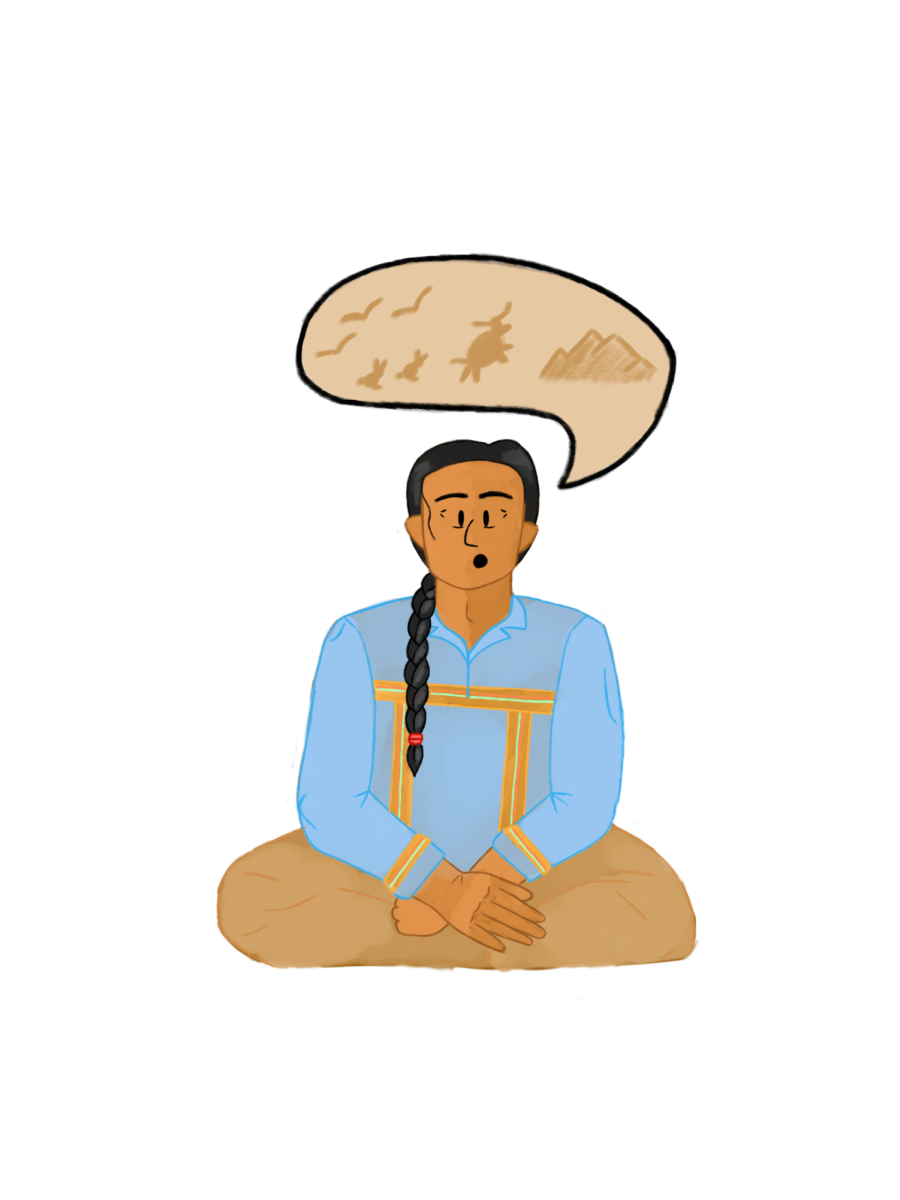
Storytelling across families as well as the blending of literary forms, such as poetry, comics and prose, are a staple in the Indigenous literary works recommended below. A novel, poetry and young adult fiction are among the recommendations that offer insight into the stories of a variety of North American Indigenous tribes.
Leslie Marmon Silko’s ‘Ceremony’
Tayo, a mixed-race man, returns home to the Pueblo people after fighting in World War II in Leslie Marmon Silko’s “Cermenony.” As he experiences post traumatic stress disorder, Tayo begins to confront the immense loss of his cousin Rocky and his uncle Josiah. Silko intertwines multiple timelines so that Tayo’s story of becoming and tragedy applies to the Pueblo people as a whole. “Ceremony” transcends the confines of a novel by immersing poetry within prose. Some chapters are told using a combination of the two, while others reveal the narrative entirely through stanza. Silko employs Tayo’s grandmother to pass along the Pueblo people’s folklore to Tayo and the reader. The grandmother’s storytelling, coupled with interlaced poetry, emphasizes the oral tradition of the Laguna Pueblo people. Silko’s “Ceremony” not only brings to light a story of the Pueblo people but also shines light on a literary tradition — oral histories — that are at times overlooked in American literature.
Layli Long Soldier’s ‘Whereas’
Written in response to S.J. Res 14 — an apology to the native peoples of the U.S. — Layli Long Soldier’s “Whereas” breaks the structure of what one may be used to in poetry in an attempt to point out the absurdity of such an apology. The poems do not follow the stanza-structure of most English poetry; rather, Long Soldier toys with shape — at times writing lines on the four corners of the page and at other moments employing a winding nature to her words. Belonging to the Oglala people, a subtribe of the Lakota people, Long Soldier combines two tongues to demonstrate the linguistic nature of cultures, while underscoring the deafening silence that echoes between the cultures of the colonizer and the colonized.
Cherie Demaline’s ‘Marrow Thieves’
Metiz Canadian Cherie Demaline places Indigenous People into the world of a young adult dystopian fiction novel with “Marrow Thieves.” As the last people capable of dreaming, Indigenous tribes across North America are being hunted for their bone marrow. Within their marrow lies the opportunity for others to dream. The action-packed narrative discusses genocide and the importance of hope in despairing times. “Marrow Thieves” provides the opportunity for Indigenous youth to see themselves in literature, which is rare — especially in science fiction novels. A sequel to “Marrow Thieves,” titled “Hunting By Stars,” was released in October of 2021.
Sherman Alexie’s ‘The Absolutely True Diary of a Part-Time Indian’
Perhaps the most accessible of the works listed is Sherman Alexie’s “The Absolutely True Diary of a Part-Time Indian.” Alexie holds ancestry from several tribes, and he grew up on the Spokane Indian Reservation, which guided his writing. The novel tells of Junior’s adolescent struggles as he yearns to become a cartoonist despite his family’s wishes. Simultaneously, Junior must face puberty, shifting friendships and poverty. Despite the heavy subject matter, Alexie tackles the topics with fervorous humor accompanied by cartoons.