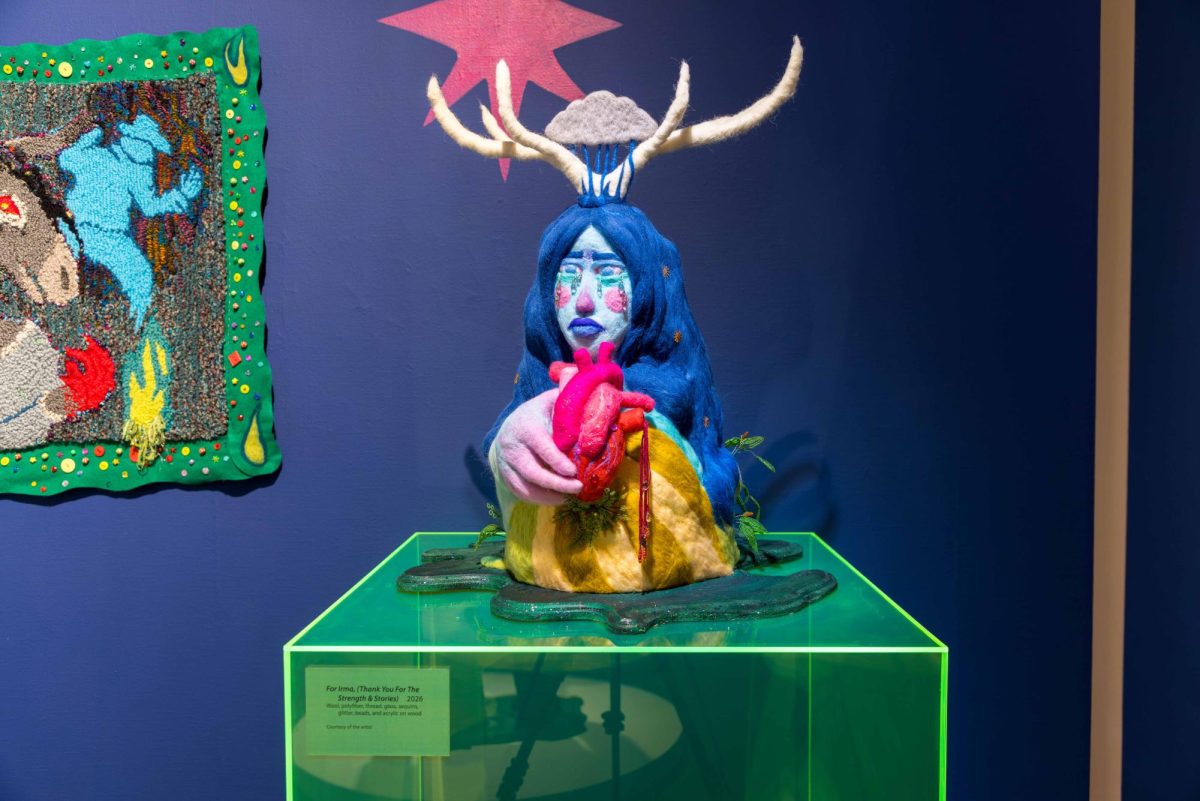
UT San Antonio alumnae Jayne Lawrence and Leigh Ann Lester feature 2D and 3D artwork in “Thorns & Living Systems,” the latest exhibit to be featured in the Russell Hill Rogers Gallery located at the UT San Antonio Southwest Campus.
The juxtaposition of the wild, natural world, symbolized through organic shapes and a lack of bold contour lines, along with the human form underscores the developing perspective of childhood wonder as it becomes exposed to art. Many of the sculptures generate imagery that one may find in the words of Lewis Carroll’s “Alice’s Adventures in Wonderland,” especially Lawrence’s “The Innocent.”
The sculpture, created using mixed forms of media, places a white furry creature with the silhouette of a bunny upon a merry-go-round. Notably, the carnival attraction does not feature the typically seen rideable animals. Instead, Lawrence opts to place organic figures that invite viewers to fill the gaps between their imagination and the perceived reality she creates. Stylized brushing of the large white figure resembles a face, but ultimately the viewer is forced to complete the visual. Although the vibrant, warm colors of the merry-go-round cultivate a sense of nostalgia, it does little to comfort against the eeriness of the taxidermy-reminiscent figure sitting atop the ride.
“I’m a narrative artist,” Lawrence reflects. “I work on developing some kind of story that you step into. When you step into my story, I’m not giving you a conclusion or telling you how to think. I’m just giving you clues that direct you along a path, and you’re to implement your own feelings, expressions, experiences into those narratives and see what you come out with.”
Unlike other exhibits featured in the Russell Hill Rogers Gallery, “Thorns & Living Systems” provides viewers with a distinct starting point highlighted by the neon buzz of Cathy Cunningham Little’s sign that reads “Cactus Bra” with a yellow arrow directing the audience’s walk towards a wall of Lawrence’s and Lester’s graphite works.
“F*#!ball” by Lawrence once again engages a literary mind. However, rather than the enchanting curiosity of Carroll, Lawrence fixates on a more dystopic dynamic between the natural world and the human form that alludes to Franz Kafka’s line, “As Gregor Samsa awoke one morning from uneasy dreams he found himself transformed in his bed into a gigantic insect.” Legs that one can only assume are attached to a body become muddied as bugs — possibly cockroaches — and emerge with a closed shape, accented by subtle yet present contour lines.
The graphite drawing occupies the bottom right corner of the paper, leaving much of the piece as negative space. The lack of shadow and the absence of imagery in the background situate the image in a dream-like landscape — a testament to the might of Lawrence’s creativity, and acknowledgement of her imagination’s limits as a definitive landscape remains unrendered. Instead, the blank canvas calls upon the viewer to interact with the piece by infusing their own imagined terrain.
Lester’s graphite images take a different approach to engaging audiences. Rather than working with missing forms, Lester presents viewers with two images placed atop each other. “Mutant Generate” depicts a more threatening perspective of nature. The forms toy with textures through frazzled and jagged contour lines that only become further distorted in the image in the background. The ghostly plants require a closer look to notice its details, and through the background’s invitation, audiences become ingrained with the bolder foreground image that invokes hostility.
The grandeur and, at times, frightening natural world yearns for engagement in “Thorns & Living Systems.” The exhibit featured at the Russell Hill Rogers Gallery will be on display until March 28. The gallery located at 1201 Navarro St. is free and open to the public Thursday-Saturday from 12-5 p.m.