Rich in culture, expressive in movement and transformative in feeling are just some expressions that best describe the San Antonio Museum of Art’s exhibition “New African Masquerades: Artistic Innovations and Collaborations.” According to the Kelso Curator Emily Ballew Neff, the exhibition, featuring four artists from West Africa, is SAMA’s first African exhibition in 20 years.
Masquerade is a broad set of practices in which individuals and societies dance in full-body, multimedia ensembles. David Sanou, Sheku “Goldenfinger” Fofanah, Chief Ekpenyong Bassey Nsa and Hervé Youmbi eccentrically portrayed their masquerade ensembles. Each artist worked with a different curator that helped design the exhibition. Two were in attendance during the press preview.
Associate Professor of Art History at the University of North Carolina in Charlotte Lisa Homann presented the first artist whom she personally worked with: Sanou. He is based in Bobo-Dioulasso, Burkina Faso. Homann presented various masquerade characters honoring Sanou’s father André Sanou. His father passed away in 2015 but had a huge impact on establishing the foundation of his son’s artistic growth.
“He wanted to show the world what his father did,” Homann described in regards to Sanou’s photo masquerade ensemble in honor of his father. “His father was not only a brilliant and accomplished sculptor, but he was also a veteran of the Algerian War.”
In Sanou’s home district, it was prohibited for the humanly realistic masquerade ensemble of his father to be presented. The presentation at SAMA of Sanou’s father not only demonstrated loyal devotion towards his father but also established a life-lasting respect for what his father meant to him.
The expressionless human masquerade, wearing a cap while holding a dagger, was frozen in time as if the individual was walking toward the observer.
Associate Professor of Art History at the University of Miami in Ohio Jordan Fenton presented Goldenfinger and Bassey Nsa. Goldenfinger is from Freetown, Sierra Leone, and Bassey Nsa is from Calabar, Nigeria. Both artists tell elaborate stories in the intricate details presented in their masquerades but are impressively opposite in their portrayal. The “Woman Tote Man” masquerade ensemble by Goldenfinger is dynamic and transformative.
“Men need to ride on the shoulders of women to achieve success, which is the subset, subnarrative of the Sierra Leonean ideas,” Fenton emphasized. “If you look at the color from top to bottom, the red, white and blue switch to red, blue and green. The artist is demonstrating that cross cultural relationship with Sierra Leone and the United States.”
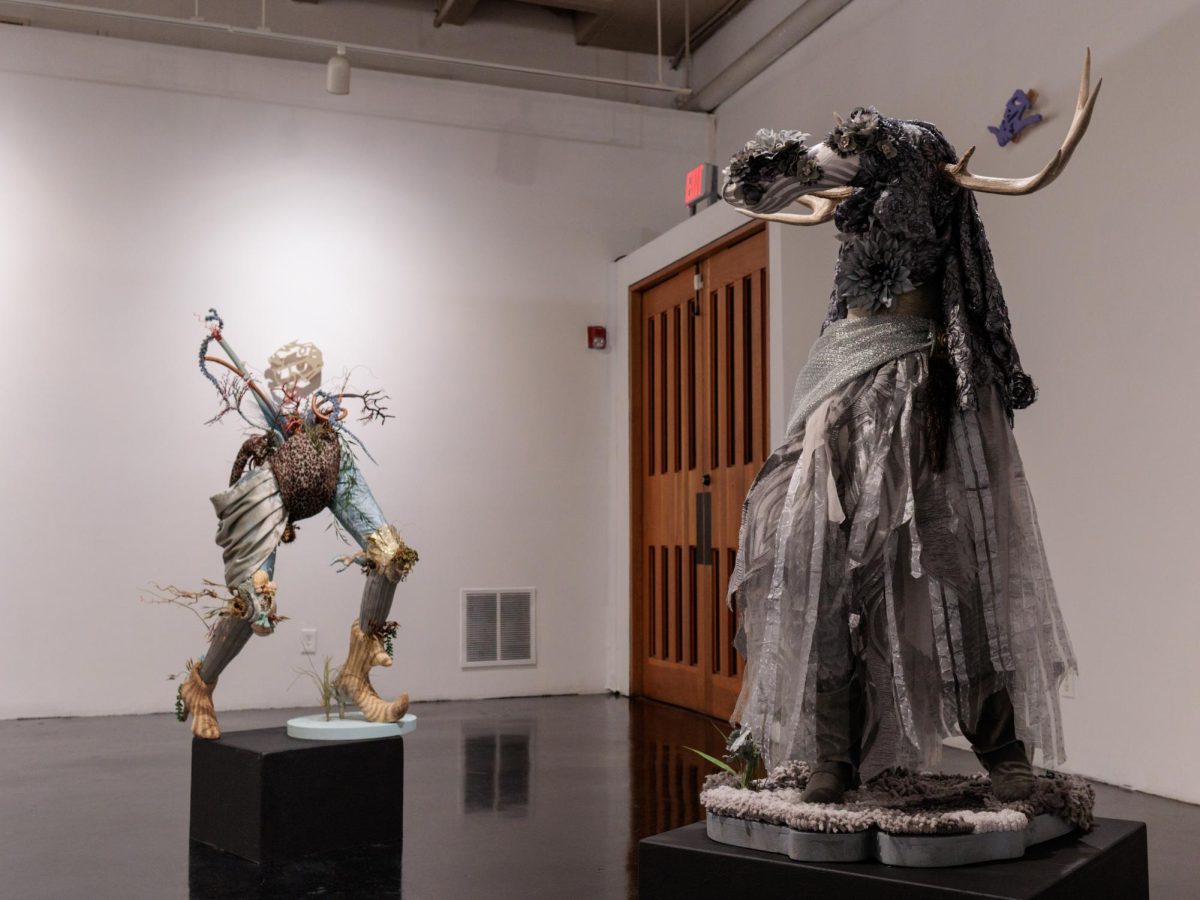
In comparison to Bassey Nsa’s masquerade ensembles, they are dynamic in shape and deliberate in movement. The fascination of capturing a specific position in motion with his masquerade ensembles is consistent in Bassey Nsa’s section of the exhibition. “Idem Ikwo” is one of the four masquerade ensembles that Bassey Nsa designed. Its vibrant red color transcends the black color blocking — visually and physically taking up space with materials such as feathers, polyester fabric and raffia.
Curator of Latin American Art of SAMA Kristopher Driggers went into detail describing Youmbi’s masquerade ensembles featuring an interpretation of the Ghostface mask from the “Scream” movie franchise. Youmbi resides in Douala, Cameroon, and his collection unconventionally featured the paperwork filed to transport his art pieces.
“Part of the artwork are the shipping documents, bills and receipts — things that museums almost never display in part because museums tend to conceal the work of moving art across continents,” Driggers explained. “But here it is really essential to the artwork.”
The “Tso Scream Mask, Visages de masques” is vigorous with the meticulous beading throughout the entire masquerade ensemble. It is easily recognizable in its deliberate pop culture reference but undoubtedly rooted in African culture as it includes materials such as wood, fiber beads, textile, horse hair, velvet fabric, cotton fabric and silk embroidery.
New African Masquerades opened to the public on Feb. 28 and will be on display through July 5. Student admission prices are $14, senior and military prices are both $19 and regular adult prices are $24. A lecture presented by Amanda M. Maples, detailing the collaboration across continents, is scheduled for March 3 from 6-7 p.m. and will formally introduce New African Masquerades.