Behind every death-defying gun fight, car chase and bare-knuckle brawl on the big screen is a stunt coordinator with a team of stuntmen and stuntwomen who put their bodies on the line to bring action-packed sequences to life.
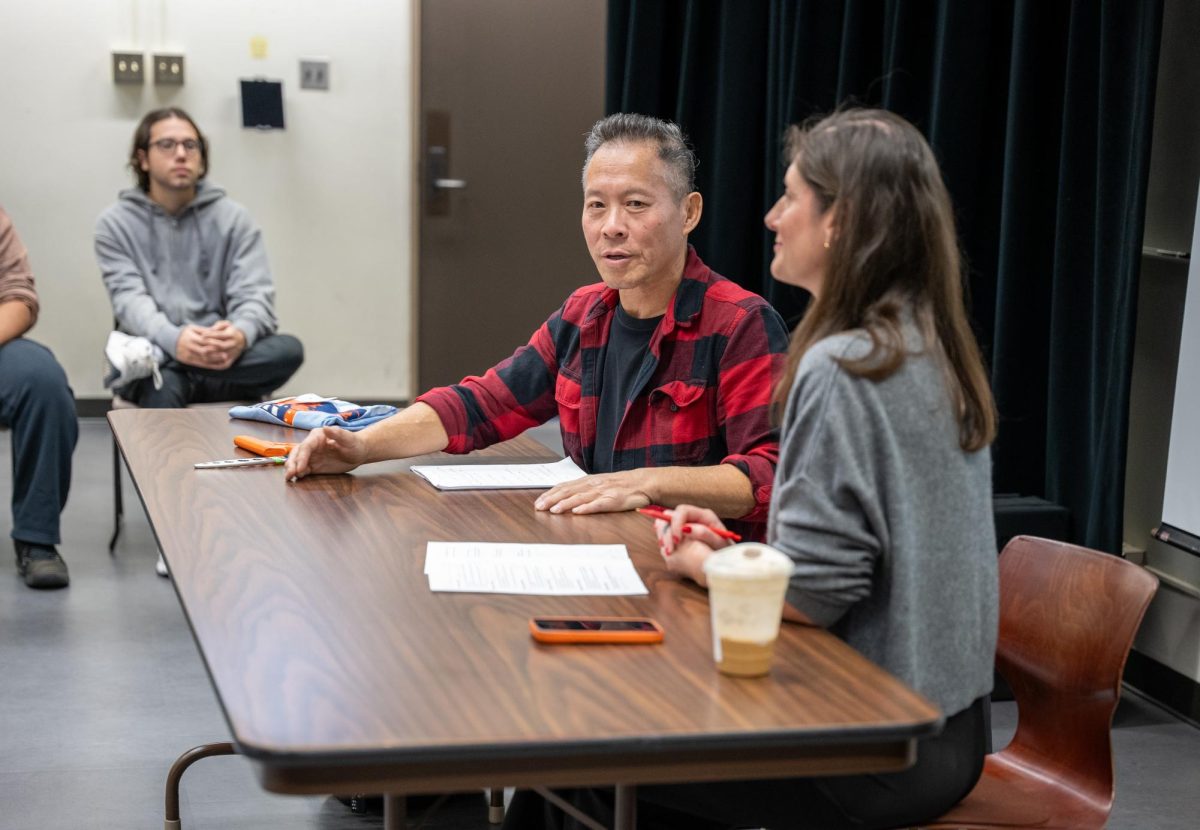
One of the best stunt coordinators in the business, Will Leong, made an appearance at UT San Antonio’s Main Campus on Jan. 14 to break down the inner workings of action filmmaking.
Leong initially detailed his beginnings in a rough part of San Francisco’s Chinatown. The people he surrounded himself with were in and out of jail or stagnating on streetcorners for years on end; he soon saw himself heading down a similar path.
“In my late teens, early 20s, I realized I didn’t want to be stuck in San Francisco, Chinatown,” Leong admitted. “Growing up, I saw guys that graduated from high school or junior college, and they were hanging out down in Chinatown selling firecrackers and doing that life.
“There’s more to life than a street corner. You want respect, but you can gain that respect in other areas.”
Leong pivoted and pursued esteem in the world of stunting. Oddly enough, it was his fears that sparked this change.
“I have a phobia about a lot of things in life. That’s why I think to me stunts [are] really my calling,” he revealed.
Consistency is what Leong credits his successful career to, spanning 35 years and nearly 300 shows and films. He picked up any stunting opportunity that came his way, honing his craft and earning the title of professional stunt coordinator and choreographer.
According to Leong, “The responsibility of a stunt coordinator is [the] safety of everybody on set.” However, he went on to explain how his profession encompasses more than just that.
Outside of learning scripts, developing the stunt choreography and submitting previsuals, stunt coordinators vet actors to see if they are capable of executing their upcoming stunts, or find someone who can perform in the actor’s place.
“I think the stunt community makes every endeavor into finding the right double — gender-wise, ethnic-wise, size-wise, talent-wise — to stunt double an actor or actress,” Leong said.
Stunt rigging is another major factor; trusses, pulleys, cables, carabiners, harnesses and a wide array of safety equipment are often necessary to perform stunts safely. The coordinators and their teams need to be well-versed in using such equipment.
Budget constraints and disagreements with production teams have occasionally hindered Leong’s work, along with many other stunt teams in the film industry. Cut corners may compromise the safety of stunting and leave coordinators liable for injuries or deaths that occur on set. They need to know when and how to speak out against that.
“My feeling is not good enough to stop this whole machine that’s rowing along. There’s 15, 20, sometimes hundreds of people on this, and my word should not be able to stop everything. You gotta come with evidence, with back up,” Leong said. “Tell me why it’s not safe. You have to go into details as to why you feel the way you feel.”
At times, stunt teams have to walk off a set entirely.
“It doesn’t have to be danger on set,” he added. “When you feel the time is right, there’s a point of no return. You have to make that call.”
Leong went on to reflect on how his line of work has evolved from his start in the 90s.
“The best residual time was during VHS tape days and primetime TV, network TV, feature films — that was the only game in town,” he reminisced. “Today, there’s a lot of streaming, and we have to try and get a better contract, but it is what it is.”
Perceptions and attitudes towards Leong’s profession have shifted as well, resulting in adaptations within the stunting community.
“Years ago, I think stunt people had more respect on set,” he noted. “Unfortunately, because the stunt person is an unsung hero, sometimes we won’t even get credit. So that’s part of our work. It’s not only to perform stunts. The other part of our job is to promote yourself with Facebook and on Instagram, any other platforms that you can use to advertise this.”
The importance of social media for gaining visibility and networking was stressed heavily by Leong, for veterans and rookies alike. Any opportunity to advance one’s craft and enhance their intellect proved invaluable to him.
“Take courses, take workshops,” Leong urged. “I don’t advocate taking every workshop. Not every workshop is gonna qualify for what you need, but learn from people. Learn from other people’s mistakes.
“If you’re working on a nonunion film, or even a low-budget film, or even a big-budget film, and you see the stunt team performing a fight or a stunt, study what they’re doing.”
It is not every day that college students get the chance to sit face-to-face with industry professionals, but when such a chance encounter comes along, they have no choice but to take action.
To keep an eye out for upcoming guest speakers and events, follow @utsafilmstudies on Instagram or send “subscribe” to their mailing list, [email protected].