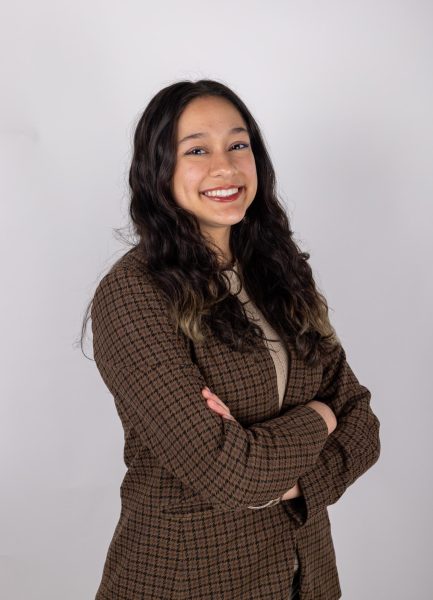
A group of nine UT San Antonio freshmen has advanced to the semifinals for the international Siemens Immersive Design Challenge. For this competition, the freshmen group designed a robot named “Robo Rowdy” to manage large-scale 3D print farms.
Of 1,900 entries, the UT San Antonio team was one of eight American teams to have made the semifinals. Freshman engineering major Israel Elizondo explained that creating a team of freshmen would shed light on a class that is often under-represented in professional settings.
“We wanted to do mainly freshmen because freshmen don’t really get the opportunities to showcase projects that they’ve done and a lot of internships,” Elizondo said. “They don’t hire freshmen. They hire juniors [and] seniors, so we just wanted to have an opportunity to take what we learned in the classroom and apply it in a real-world sense.”
The competition’s objective is to craft a product or process with improved sustainability by utilizing immersive engineering. Freshman engineering major and Siemens technical intern Jacob White explained how sustainability was incorporated into the team’s work.
“Sustainability could mean a wide range of things,” White clarified. “Either reducing environmental impact, reducing material waste or, for this project specifically, some of the sustainable impacts [are] using 3D printing to make the robots, but also by making the entire process more efficient.”
The team chose to focus on 3D printing farms for their robot. Elizondo detailed that this choice was because of the growing additive industry.
“We had complete freedom [to pick the topic],” Elizondo said. “We wanted to target the added-manufacturing industry, which means adding material — additive manufacturing — because it’s a growing industry.”
When explaining the challenging aspect of creating the robot, Elizondo reflected on adapting its virtual model into a physical model.
“When we’re CADing the robot — CADing is 3D modeling it — so in the virtual space, it’s a perfect space,” Elizondo said. “Everything works perfectly how they should. However, when you translate it into the real world sense, things don’t really work out, so that was one of the biggest obstacles and setbacks.”
Although the team collaborated on an engineering project, not all members are engineering majors. The team is composed of engineering, computer science and business majors. Dyshana Torres is one of the two computer science majors of the group and incorporated artificial intelligence and application programming interphase into the robot.
“For the AI, we worked with cameras, and we have two NVIDIA Jetsons,” Torres stated. “One is handling print management, so it connects externally to a cloud platform that 3D print farms usually use. We use SimplyPrint for Farm Pro, and it uses APIs to connect with the printers over the internet, and we use AI through the cameras. We use object avoidance.”
Torres continued to explain that the AI software detects mistakes in the field prints.
“It would use a database of what normal prints look like, and then what it shouldn’t look like. And if it detects what it shouldn’t look like, it will then create a command using that API,” Torres explained. “We have a Python script, it will send that command and then stop the printer.”
Elizondo said that winning this competition could provide the team with career opportunities and produce media attention for UT San Antonio.
“It would open up career opportunities, possible internships or just overall collaborations,” Elizondo considered. “Mediawise, doing something like this could be something big, just exposure and showcase our skills.”
The team will find out on April 27 whether they made it to the final round. If they win, the students will have access to Invitations to Realize LIVE 2026, Training with Siemens experts in-person or online, career development opportunities, certificates, digital badges and certification vouchers.