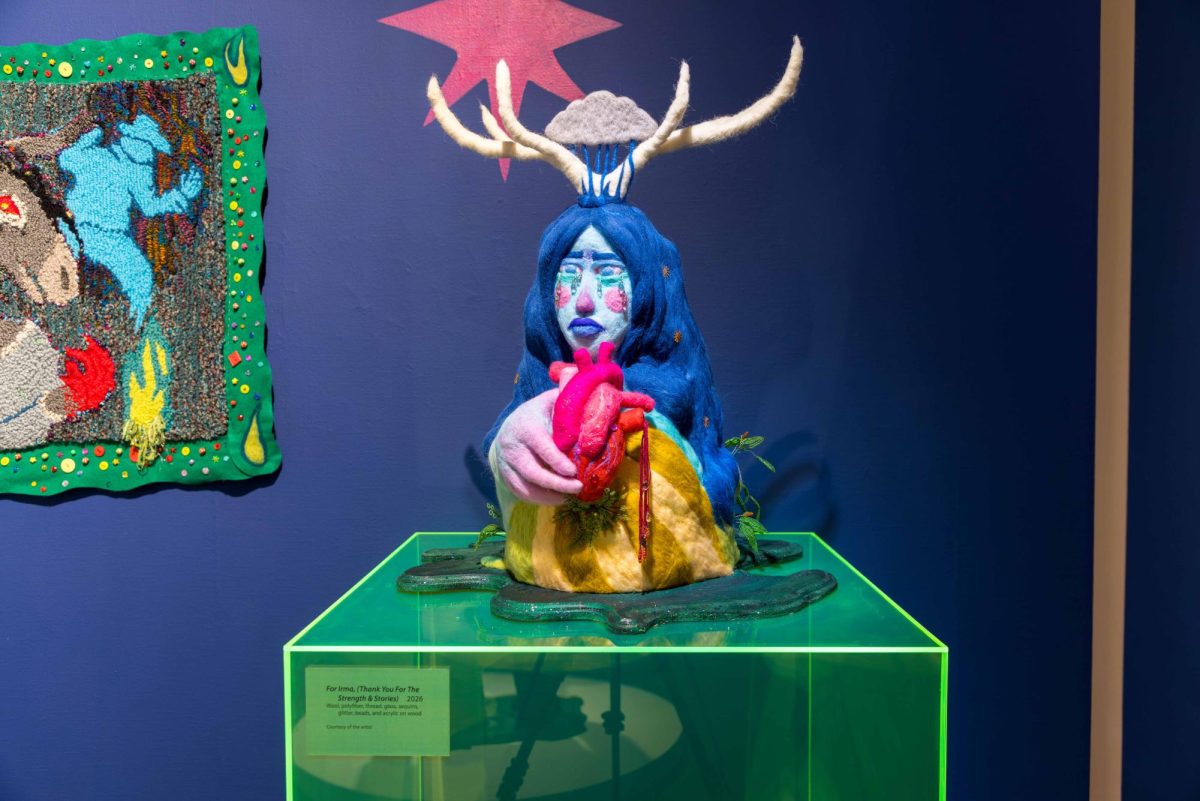
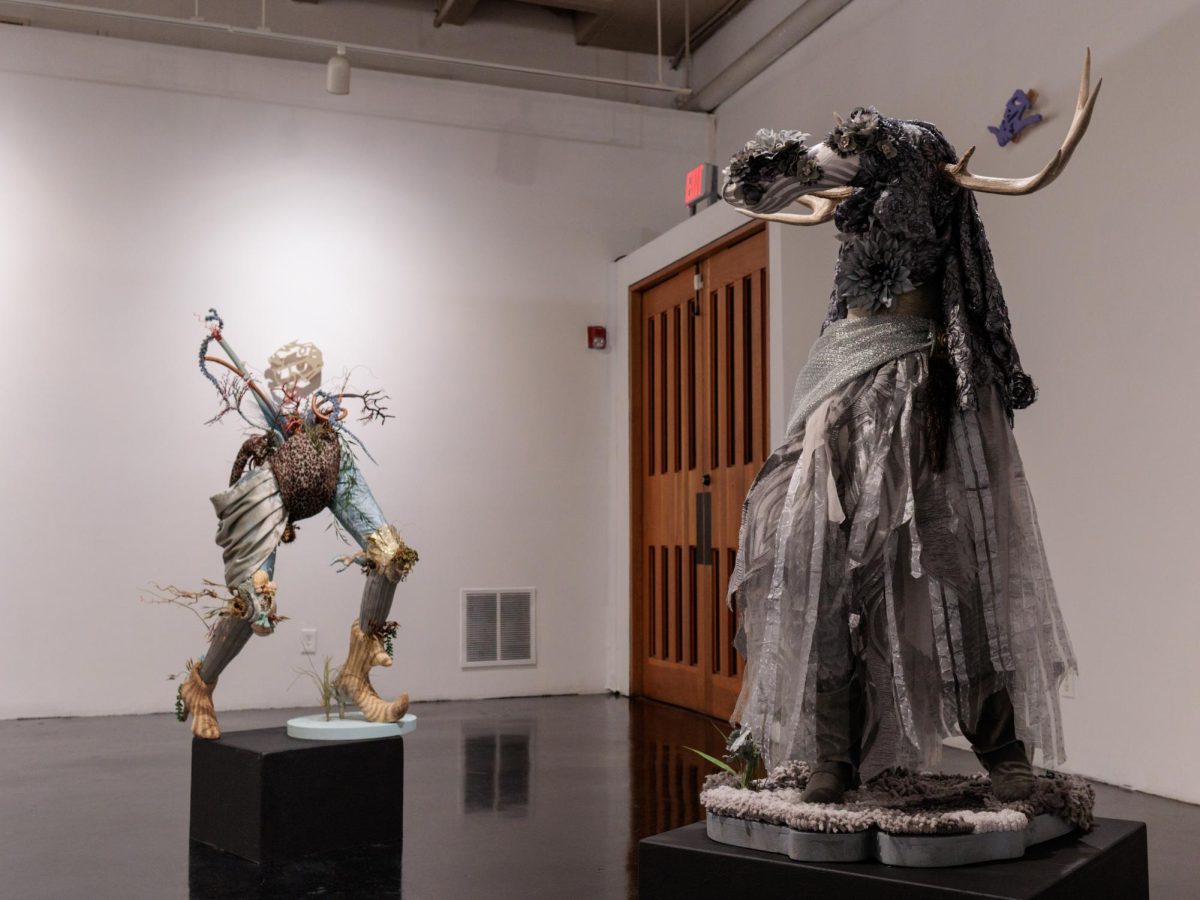
The “XXII Biennial Faculty & Staff Exhibition” features artwork across numerous mediums, showcasing the individual abilities, perspectives and work of the UT San Antonio School of Art faculty and staff.
Professor of Art and Art History Chris Sauter displayed a piece titled “Transmitter/Receiver” made in 2024 from a 3D printed polymer clay, paint and tree bark. Sauter’s work shows a satellite dish attached to a piece of tree bark with mushrooms stemming from the same piece of bark. Sauter’s background explores the links between biology, culture and the dissonance of time.
“Transmitter/Receiver” is a perfect example of links between the past and present, juxtaposing the tree bark and mushrooms’ longevity on Earth with a man-made satellite dish facilitating modern communication.
Professor of Art and Art History Alán Serna showcases a piece titled “El Paño Poderoso (The Powerful Bandana)” made this year of a cyanotype on a bandana. The cyanotype shows a gardening glove over the outline of somebody wearing a sweater. The top right corner has text with a heading reading “ORACION A LA MANO PODEROSA (Prayer to the Powerful Hand).”
The subsequent text reads the prayer mentioned in the heading, following imagery and a prayer card for “La Mano Poderosa,” which is a Catholic prayer with a depiction of Christ’s hand with figures of Jesus, the Virgin Mary, Saint Joseph, Saint Joachim and Saint Anne.
The prayer is looking for mercy in a distressing situation to open beneficial paths. God is asked to forgive past mistakes and give the worshipper strength to tolerate the inconveniences of life. The prayer must be recited for 15 days. Eight days after this prayer is completed, all prayers are answered, no matter how difficult. Serna notes that this prayer is made in hopes of new opportunities and fresh beginnings.
Bri McDonald displays a six-minute-and-33-second film titled “TEOTWAWKI Road,” the initialism reading “The End Of The World As We Know It.” AI video, stolen identities and family hallucinations are listed as materials. The film follows the premise of a girl named Bri looking for her parents in a post-apocalyptic world where she is walking down a never-ending road.
Bri runs into a friend who says they need to find her parents. She runs into her mother, who gives her a “life straw” to remove impurities from her. When she obtains the life straw, an odd, urgent voice off-screen says, “Hey, we’ve heard you’ve got the good stuff — the stuff we’ve been waiting for.”
Later down the road, Bri encounters her father, who gives her nicotine patches. He says not to trust “them,” which is interpreted as the voices off-screen asking her for the “good stuff.” She then begins running, but another off-screen voice says she is going the wrong way. The scene changes to a deer who presumably takes Bri’s place. Alongside the deer is a different girl named Grace, shown with blood on her hands and a gun in her hand after crossing paths with the deer.
With the odd nature of AI’s audio and video capabilities, this film displays a dystopian world that is made to seem alarming with the stolen identities used to create it. The film comments on the artists’ own identity as it follows the path of another. She is lost in this post-apocalyptic world, and nothing is trustworthy since everything is an imitation of real life.
Sauter, Serna and McDonald all draw inspiration from different fields of study and conflicting values with their diverse backgrounds in fine arts as well as their personal lives, making this a well-versed exhibit. Of course, these are not the only amazing faculty members with artwork on display.
There are numerous sculptures, lithographs, paintings and assemblages conveying the diverse range of the College of Arts staff. This exhibit will be showcased in the Main Art Gallery through Nov. 1 and is open Thursdays through Saturdays from 10 a.m. to 3 p.m. free of charge.